
A teaching party must not feel like Saturday school. That is the first rule. If the children smell worksheets, you are finished.
The best version I have seen was not fancy. It was a science and maths mission party in an estate clubhouse near Centurion, with three tables, one messy experiment corner, a snack table, and a host who kept moving. The children thought they were playing. The parents knew something useful was happening. Good. That is the sweet spot.
For this article I am going with one angle: a science lab party with maths challenges built into the games. Not ten themes. Not astronomy, coding, dinosaurs, robotics, and slime all fighting in one room. One clean idea. Lab coats if you want. Safety goggles if you must. But keep the plan tight.
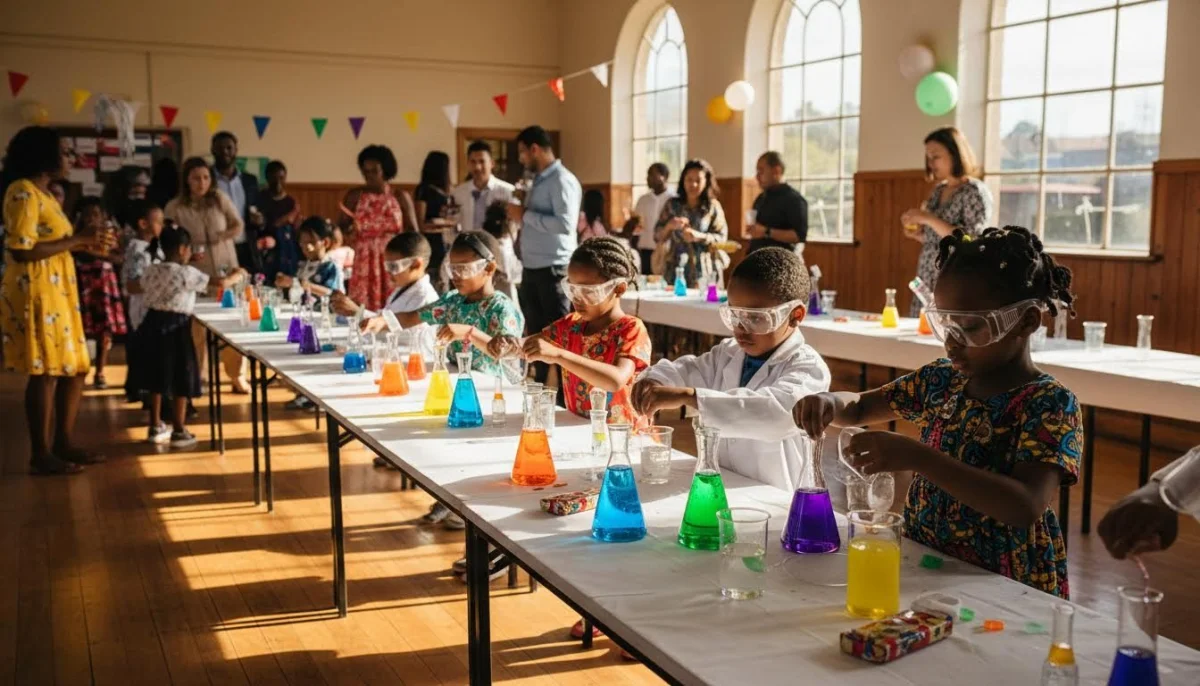
Children don’t need a lecture. They need a task they can touch. Put the activity where adults can see it, not tucked behind the cake table like an afterthought.
Start with one main mission
Call it a Lab Mission. That is enough. The children arrive, get a simple badge, and join a team. Each team earns clues by solving small science and maths tasks. At the end they open a prize box or crack a code. Done.
I know people like big themes. Ag, some hosts cannot help themselves. But a party with too many ideas becomes a shop window. Nice to look at, irritating to run.
- Pick one age band: 5 to 7, 8 to 10, or 11 to 13
- Choose four activity stations only
- Write the final goal on one board where everyone can see it
- Keep each challenge under ten minutes
- Let children repeat the fun station once, not every station
- Have one adult as the timekeeper, not the birthday child’s parent

There’s one detail that decides whether guests leave early: whether the first ten minutes have something to do. Not a speech. Not a welcome circle. Something with hands.
The four stations that actually work
I would not make this complicated. You need one wow station, one quiet thinking station, one movement station, and one food-linked station. That gives you balance. Loud, calm, loud, reward.
| Station | What children do | What they learn | Host note |
|---|---|---|---|
| Fizz Lab | Mix vinegar, bicarb, food colouring, and guess which cup reacts fastest | Prediction, reaction, measuring | Put this on a plastic tablecloth. Do not be brave. |
| Code Table | Solve number clues to open a small lock box | Patterns, addition, logic | Use big printed numbers. Children crowd. |
| Shape Relay | Build a tower from cups, sticks, and elastic bands against a timer | Geometry, balance, teamwork | Keep spare cups nearby. |
| Taste Test Maths | Guess flavours, count votes, and make a quick bar chart | Data, fractions, comparing results | This is where snacks help you. |
At a school hall, check the rule about liquids before you arrive. Some halls are weirdly strict about anything that can stain. I once saw a caretaker guarding a polished floor like it was a newborn baby.


Where hires make sense, and where they don’t
Hire only the parts that need skill, gear, or proper delivery. Do not hire a person to hand out pencils. That is madness.
For this kind of party, I would consider three things only: Trivia Hosts, Kids Furniture, and Buffet Catering. Those exact hires can carry the awkward parts, the flow, the seating, and the food. The rest can be simple.
A good quiz host is useful if the children are older, say 9 and up. They can run rounds, keep score, and stop the bossy cousin from taking over. For a proper Saturday booking in Joburg or Cape Town, budget around R4,500 - R9,000 for a structured children’s quiz or activity host, more if they bring screens, props, and assistants.
Small furniture matters more than people admit. If the chairs are too high, children kneel. If tables wobble, the experiments spill. Low tables and small chairs can cost around R2,800 - R7,500 depending on quantity, delivery area, and styling. This is boring money, but it works.
Food is the other place to be sensible. If you book proper food for the main meal, let them handle timing and hygiene. Then fill small gaps yourself. Mini samoosas from an Indian deli in Fordsburg go down well with adults. Koeksisters from a padstal on the N1 work for the oumas and the dads who pretend they are just having one. Popcorn buckets from a cinema candy shop are good for the final clue session, and yes, Nu Metro-style buckets make children feel like something is happening.
| Part of the party | Book it if | DIY it if | Realistic cost note |
|---|---|---|---|
| Activity host | You have 15 or more children and need structure | You have confident adults who can run stations | R4,500 - R9,000 for a proper host package |
| Child seating | The venue has adult chairs only | You already have suitable tables at home | R2,800 - R7,500 with delivery and setup |
| Main food | You want hot food served on time | You only need light snacks around cake | R180 - R380 per person is normal for decent party food |
| Decor | You want a polished lab look | You can print signs and use simple colour coding | Spend less here before cutting food or seating |

Make the room look clever, not cluttered
I pretend not to care about decor, but I do. A clean room helps children understand where to go. It also makes photos look less like a staff meeting with cupcakes.
Use colour zones. Blue for science. Yellow for maths. Green for snack data. Red for final challenge. This helps the children move without ten adults pointing and shouting.

You don’t need expensive props everywhere. Clear signs beat piles of themed clutter. If the child can read the table from three metres away, you have done well.
Most People Forget
Guests care more about
- Knowing where to stand
- Seeing the activity clearly
- Getting food before children melt down
- A host who keeps time
Than
- Ten matching posters
- Complicated dress-up rules
- Tiny labels on every jar
- A giant backdrop nobody uses
One blunt opinion: themed cupcakes with tiny edible formulas are usually a waste. They look clever for six minutes and then someone bites off the plus sign.
The party flow, because children have a battery life
The timing must be tight but not military. Children need a start, a middle, a food pause, and a finish. If you leave a dead gap, they will create their own entertainment, and it will not be educational.
| 0:00 | Children arrive, collect badges, choose a team colour |
|---|---|
| 0:10 | First quick challenge, something easy so nobody feels stupid |
| 0:25 | Fizz Lab or tower build, the noisy hands-on bit |
| 0:45 | Snack pause and water, adults stop asking if cake is soon |
| 1:00 | Code Table and taste test maths |
| 1:25 | Final clue, prize box, group photo |
| 1:40 | Cake, party packs, goodbye before the room turns feral |

A Good Lab Party Has A Rhythm
- Children arrive and find their team colour
- First clue is easy and fast
- One messy station gives the party energy
- Food slows the room down
- Final code pulls everyone back together
- Cake happens before patience is gone
This is where the earlier point pays off. If the first ten minutes are active, the room settles. Children who start with purpose behave better later. Not always. But enough that I will argue about it.
Keep the learning light, but real
Do not fake it with science words stuck on normal games. If you say it is maths, make them count something. If you say it is science, make them predict, test, or observe. Children can smell nonsense.
The trick is not to explain everything. Leave a little mystery. Ask, “Which cup will fizz higher?” and then let them test. You do not need a speech about carbon dioxide unless someone asks. And if one child asks, answer that child, not the whole room for seven minutes.
| Age | Good activity | Avoid |
|---|---|---|
| 5 to 7 | Colour mixing, simple counting, tower building | Long rules and written worksheets |
| 8 to 10 | Codes, team scoreboards, timed experiments | Babyish props and too much adult help |
| 11 to 13 | Escape-style clues, logic rounds, harder building challenges | Anything that feels like a kiddies party |
But will teenagers stay engaged past 30 minutes? Some will, if the challenge has status. Put a scoreboard up. Give them a proper timer. Let them beat another team. A little pressure wakes the room.


The small admin that saves your nerves
Send parents the theme, start time, end time, and clothing note. Say messy activity clearly. Say closed shoes if you are using a hall or clubhouse. You are not running a secret society.
Do a simple consent note if there are food tastings or messy substances. Keep it normal. Nobody wants a legal document for jelly cups, but allergies are not a joke.

Pack supplies by station, not by item type. One tub per table. I made the opposite mistake once and spent half the party looking for elastic bands in a bag of serviettes.
Do I need real lab coats?
No. Oversized white shirts work. Real coats look nice, but they are not the party.
Should parents join the activities?
Only if the children are very young. For older children, parents should watch from the snack side.
Can I do this at home?
Yes, if you have shade, a wipeable table area, and enough space for teams to move without bumping the food.
What I would spend on, in order
First, spend on the activity flow if you cannot run it yourself. Second, seating. Third, food. Then look at decor. That order will annoy people who love pretty things first. I like pretty things too, but a beautiful table does not stop twenty children from getting bored.
| Priority | Spend here | Why |
|---|---|---|
| 1 | Activity leader or proper station plan | This controls the whole afternoon |
| 2 | Child-sized tables and chairs | Comfort makes the tasks easier |
| 3 | Main food and drinks | Hungry children turn strange |
| 4 | Clear signs and colour zones | Good enough decor that also guides people |
| 5 | Extra props | Only if the budget is still healthy |
If the party is in Durban humidity, keep chocolates away from the activity tables. If it is a Gauteng afternoon, put water out before anyone asks. If it is Cape Town and the wind is being dramatic, tape the clue cards down. I said I would not over-explain everything. There it is.

The party is working when the children are arguing about the answer, not asking for a phone.
Uncle Gert
Keep the theme simple, make the first activity immediate, and spend money where it carries the day. If you need a host, child seating, or proper food, sort that before you buy another packet of plastic test tubes.
Comments (1)
Join the conversation — no account needed. Comments are moderated before they appear.
Leave a comment