
A party for 100 people is not a bigger version of a dinner for 20.
It behaves differently. People arrive in waves. Drinks disappear faster. The first uncle chooses the best chair and somehow becomes part of the furniture. Someone parks in front of a gate. The host spends 30 minutes saying, yes, food is coming, even when food is already on the table.
The trick is not to plan more. It is to plan fewer things properly.
I like a large party that feels open, not packed. A school hall in Pretoria can feel beautiful if the tables breathe and the lighting is warm. An estate clubhouse in Durbanville can feel miserable if the bar is in the wrong corner and everyone queues against the sliding door.
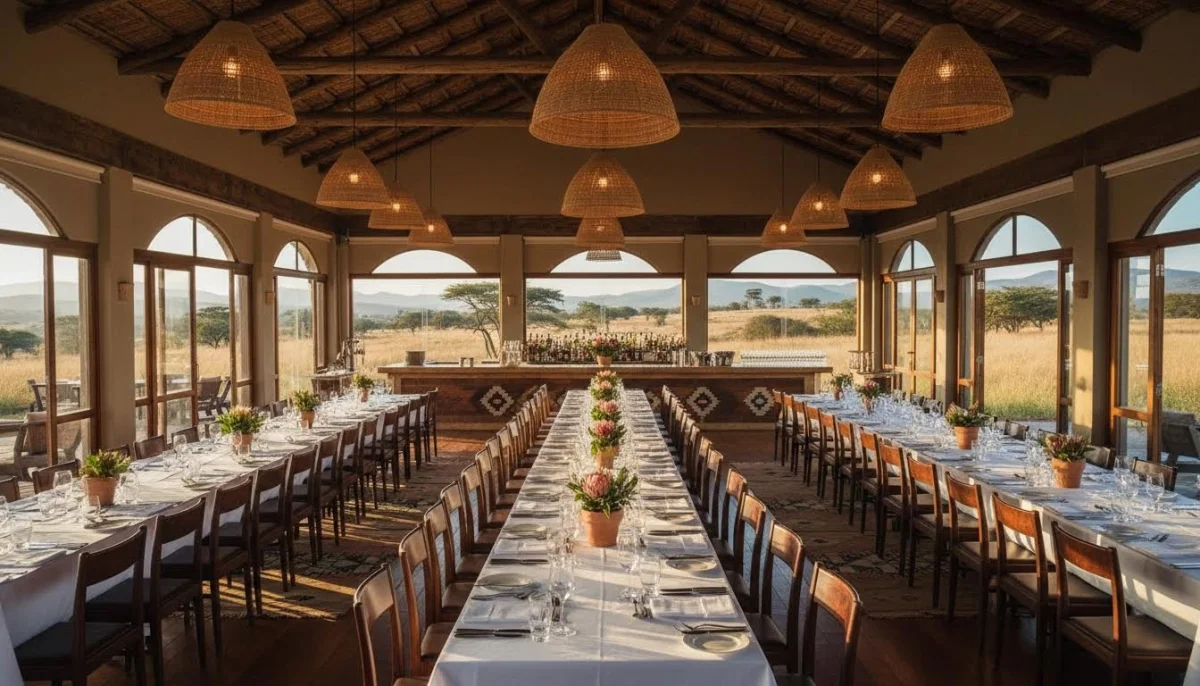
There is one detail that decides whether guests leave early, and it is not the cake. It is whether the room makes sense after the first 40 minutes.
That means guests can find a drink, sit without asking, hear the speeches, see where the food is, and move without brushing past a speaker stand. Very dull. Very powerful.
For TimeToParty planning, this is where a few hired services earn their money. Not a catalogue of toys. Just the pieces that stop a big group from turning into a slow human traffic jam.
Start with the room, not the theme

Large groups need space that reads quickly. Guests should understand the room in five seconds: food there, drinks there, speeches there, bathrooms somewhere obvious.
Themes are fun. I still enjoy a table with good linen and one clean colour story. But for 100 guests, the theme must sit inside a plan, not on top of a bad one.
The first question is not, what shade of sage green. It is, where will 30 people stand when they arrive at the same time.
Big parties often start badly because the entrance area is treated like a doorway, not a holding zone. Guests pause there. They greet. They look for the host. They block the auntie carrying flowers wrapped in Pick n Pay paper. Nobody means to, but it happens.
Most People Forget
Guests care more about
- A clear place to put gifts
- Enough chairs near older relatives
- Food and drinks that are easy to find
- A room that does not echo every fork scrape
Than
- Tiny favour tags
- An overfilled welcome board
- Matching napkins on every surface
- Decor nobody can see once people arrive
A venue visit matters. Not a quick look while someone is setting up for another function. A real visit, ideally at the same time of day as your party. Light changes everything. So does noise.
Odd detail, but useful: some clubhouses have a rule about no red wine near cream couches. I once watched a committee member point at the couches before she said hello. That told me everything about where not to place the drinks table.
Build around four zones


I use four zones for large groups: arrival, drinks, food, and sitting. If there is dancing or a big game, that becomes a fifth zone. Keep them separate enough that people move naturally.
This is the part that sounds boring and saves the day.
- Arrival needs a visible gift table, a place for bags, and someone who is not the host to direct people.
- Drinks need ice, shade, bins, and space for a small queue.
- Food needs two access points if possible, especially for buffet service.
- Sitting needs variety: tables for eating, soft seating for older guests, open edges for people who hover.
- The music or speech area must not face a wall unless the wall is doing something useful.
For 100 guests, I would rather hire fewer, better pieces than fill a space with thin decor. One strong bar, enough seating, a proper sound plan, decent food service. That is the bones.
Blunt opinion: chair covers should be left in 2009 unless there is a very specific reason. A clean chair looks better than a tired white cover with a satin bow trying too hard.
Choose a few hires that remove pressure
Hires to book: Party Hire Equipment, Furniture Hire, Catering & Drinks, Security Guards.
That is the short list I would consider before anything flashy. Not every party needs all four. But for a 100 plus birthday, anniversary, year end family lunch, engagement, or milestone church hall celebration, these are the ones that change the host's actual day.

Tables, chairs, service stations, umbrellas, bins, and bar counters are not glamorous. They are the quiet machinery of a big party.
For equipment and furniture, prices depend on quantity, delivery distance, weekend timing, and damage deposits. For a proper 100 guest setup, expect the basics to land around R12,000 - R35,000, and more if you add lounge pockets, bar counters, umbrellas, linen, crockery, and outdoor flooring.
Do not build your budget around the cheapest chair price you saw online. Delivery, collection, setup time, and breakages are where the bill gets its shoulders.
| Need | What it does | Realistic planning range |
|---|---|---|
| Seating and tables | Gives guests a place to eat and rest without hunting for chairs | R8,000 - R25,000 depending on style and quantity |
| Food and drink service | Feeds guests in waves and keeps drinks moving | R35,000 - R95,000 plus for a substantial menu and staff |
| Basic bar or service counters | Stops drinks from spreading across random kitchen surfaces | R3,500 - R15,000 depending on build and staffing |
| Access control or parking help | Keeps arrivals calmer at estates, farms, halls, and private homes | R4,000 - R12,000 for a staffed event window |
Food is not the place to be vague. If guests are arriving after 5 PM, they expect supper. If it is a 2 PM family celebration, they may accept platters, warm trays, and cake. If there are teenagers, they will eat like a small rugby team and then stand near the cooldrink table.
Good service matters more than a dramatic menu. A slow buffet for 100 people is like watching paint dry in formal shoes.
Food flow is the real entertainment

People remember if they were hungry. They remember if the food was cold. They remember if the line moved. They do not remember the name of every canapé, unless one was terrible.
For 100 plus, I like food that can be served in waves without looking unfinished. Braai stations, curry pots, harvest tables, sliders, spit style service, mezze, pasta pans, and proper platters can all work. The issue is not style. The issue is movement.
A Big Party Should Feed People In Waves
- A small bite appears within 30 to 45 minutes
- Drinks are already moving before the main food opens
- Older guests and children get access early
- Main food opens from two sides if possible
- Cake or dessert is placed where guests can see it
- Late snacks arrive before the tired driving-home mood starts
This is why a single buffet line against a wall annoys me. It looks tidy in a photo and then becomes a border post.
Ask your food team how many service points they use. Ask whether staff will clear plates. Ask where used glasses go. These are not glamorous questions, but they change the sound of a party. A room with uncleared plates has a dull clatter, like a restaurant that has given up.
If you are supplementing the main food, keep it practical. Gatsby platters from a Cape Town takeaway work beautifully at late parties. Dim sum trays from an Asian market are good for a mixed crowd if you label them clearly. Fried chicken platters from Nando's are not fancy, but they disappear.
Make sound behave

Sound is not only for dancing. It controls speeches, background noise, announcements, and how tired the room feels after two hours.
Even if you do not book a full dance setup, you need a plan for sound. A 100 person room swallows speech. It also turns casual talking into a low roar. Add tiled floors and a high ceiling, and suddenly grandma cannot hear the toast.
If you hire sound or a DJ, a Saturday booking with proper gear can easily sit around R8,000 - R18,000, sometimes higher for late nights, travel, bigger speakers, lighting, or a ceremony plus reception setup. A microphone and small speaker from a friend is fine for 25 people. It is not fine for 120 in a hall.
The best big parties I have been to were not loud all the time. They had levels. Soft music at arrival. Clear volume for speeches. Energy later. Then a slower landing. It felt designed, like a good Nu Metro sound mix, not someone fighting Bluetooth in the corner.
- Confirm who brings microphones.
- Ask if there is one speaker zone or two.
- Keep speakers away from the food queue if possible.
- Test speeches before guests arrive.
- Give the person on sound a printed running order.
- Decide who may request songs. This is political.
There is always one person who wants the music louder before people have even finished eating. Smile. Ignore them for a while.
Keep the guest list honest

A 100 guest list is rarely exactly 100. It is 100, plus partners, plus children, plus someone your mother says must be invited because she was at the kitchen tea in 1998.
I am not against big family politics. I just think the list must be counted properly. Children count. Vendors count. A photographer eats. Bar staff need space. If your cousin brings a new boyfriend, he still needs a chair, even if nobody has learned his name.
| Count | Plan as if | Reason |
|---|---|---|
| 100 invited | 80 to 95 may attend | Depends on travel, family pressure, and how early you confirm |
| 100 confirmed | 105 to 112 may appear | Last-minute plus ones and children happen |
| 100 adults plus children | Food count is not equal to chair count | Some children share seats, but they still eat and spill |
| 100 at a home | Parking becomes part of hosting | Neighbours notice cars before they notice flowers |
RSVP deadlines work better when they are short and direct. Please reply by Friday, with the names of everyone attending. Not, let me know when you can. That sentence has ruined many hosts.
For estate clubhouses and private venues, access can be slower than expected. Security at the gate may need names or codes. If your event is in Midrand, Ballito, or Somerset West, do not assume every guest knows the gate procedure.
This is where professional gate or parking help can be useful, especially at evening events or homes with awkward streets. Not dramatic. Just calm.
Give families and older guests a better deal


If your guest list has children, older relatives, and teenagers, do not plan as if everyone wants the same party. They do not. A good large gathering has different speeds.
Children need a visible play area, not a random back room where parents keep checking with one eye. Older guests need chairs that are not trapped behind dancing teenagers. Teenagers need somewhere to stand without being treated like suspicious furniture.
If it is a family heavy celebration, a supervised kids corner can help. Not every child needs a jumping castle. Sometimes low tables, colouring rolls, giant blocks, and one calm adult are better. But will teenagers stay engaged past 30 minutes? Only if there is food, signal, and somewhere to lean.
What Looks Good Versus What Works
Expectation
- One big seating plan keeps order
- Children can play anywhere
- Older guests will sit wherever
Reality
- Mixed seating lets people move and still feel included
- Parents relax when play is visible
- Older guests choose shade, backs on chairs, and a clear path to food
I once watched a grandfather quietly move his chair three times because the speaker was aimed straight at his left ear. Nobody was rude. The layout was just thoughtless.
Let the timeline breathe

A large party needs more time between moments. Guests take longer to arrive, longer to eat, longer to settle for speeches, longer to move outside for photos. It is like steering a shopping trolley with one strange wheel, possible, but not graceful if you rush it.
Start the official part later than arrival. If the invitation says 3 PM, speeches at 3:20 PM are optimistic in a way I do not respect.
| 3:00 PM | Guests arrive, drinks open, small snacks visible |
|---|---|
| 3:45 PM | Host greeting or short welcome, no long speeches yet |
| 4:15 PM | Main food opens for older guests and children first |
| 5:15 PM | Speeches, cake moment, or family photo while people are fed |
| 6:00 PM | Music lifts, dessert or coffee appears |
| 7:30 PM | Late snacks, final drinks, quieter seating stays available |
The host should not be the only person holding the timeline. Give one reliable friend or coordinator the order of events. Someone who can say, we are cutting the cake in ten minutes, without turning it into a committee meeting.
If you have a photographer, align the photo moments with the flow. Do not drag 60 relatives away from drinks into harsh sun because someone forgot to take the big family shot.
Decor should guide the crowd

For a big group, decor has a job. It points, softens, separates, and photographs well without stealing space from people.
This is where my design bias shows. I like space. I like clean lines. I like tables where you can put down a plate without negotiating with a candle holder.
For 100 plus guests, decor should help people understand the room. A welcome table says, start here. A soft seating corner says, rest here. A cake table says, gather later. Lighting says, stay a bit.
A stylist can be worth it if the venue is plain, the photos matter, or you are mixing hired furniture with family pieces. The benefit is not only beauty. It is restraint. Someone who can say no to the fourth arch is doing holy work.
A short tangent. I still think about a 60th birthday in a church hall where the host used one colour, cream, and a row of old family photos clipped to string. No fancy installation. It looked calm. The room felt loved. Then someone brought out milk tart and the whole place softened.
Large parties do not need clutter to feel generous. They need enough, placed well.
Plan for arrivals, exits, and the quiet middle

The quiet middle is the part nobody posts. It is after first greetings, before the main food, before speeches, before dancing. If that part feels empty, guests start checking the time.
You do not need to overfill it. You need texture. Music at the right level. Drinks within reach. A few snacks. Seating that does not force everyone into one line of conversation. Children occupied enough that parents can finish a sentence.
Do I need a seating plan for 100 guests?
For formal meals, yes. For relaxed celebrations, reserve tables for older guests and immediate family, then leave the rest flexible.
How much food should I order?
Ask your food provider to quote per adult and per child. Then add a small late snack buffer if the party runs past three hours.
Is a home party realistic for 100 people?
Yes, if parking, bathrooms, neighbours, seating, and cleanup are handled. The garden alone is not the plan.
After the main moments, people split into small groups. This is good. A big party does not have to feel like one crowd all day. It can feel like several little rooms sharing the same afternoon.
If there is dancing, keep the dance area close enough to the bar that it feels alive, but not so close that people queue through the dancing space. If there is no dancing, create another focal point: cake, coffee, fire pit, dessert table, late-night gatsbys, something.
The final guest count checklist


This is the dull part I would not skip.
- Finalise confirmed adults, children, vendors, and staff separately.
- Check how many chairs are needed for eating versus resting.
- Confirm the number of serving staff and bar staff.
- Confirm table sizes before ordering linen.
- Walk the food queue route from both directions.
- Place bins near drinks, bathrooms, and exits.
- Give someone the gate list if the venue needs access control.
- Keep a small table free for gifts, handbags, or unexpected flowers.
- Pack tape, scissors, black bags, paracetamol, phone chargers, and a marker.
- Tell key family members the actual timeline, not the hopeful version.
For drinks, count ice properly. In hot weather, ice is not only for glasses. It cools tubs, bottles, garnish, and sometimes the host's mood. A freezer drawer will not carry 100 people.
For dessert, do not rely on cake alone if the event is long. A Checkers cake counter order can be useful for backup slices if the main cake is decorative or small. Keep it in the kitchen until needed. Not everything has to perform.
A large party feels generous when the host has stopped trying to control every corner.
Mia Ferreira
That is the strange relief of planning for a crowd. You cannot choreograph every conversation. You can only give the day good bones, enough food, clear sound, places to land, and a little beauty where it counts.
And then you let people be people. They will move chairs. They will stand in doorways. Someone will ask where the ice is while holding ice. It is fine... mostly.
Use TimeToParty to find the few reliable hires that carry the room: seating, food service, sound, and crowd support. Start with structure, then make it beautiful.
Comments
Join the conversation — no account needed. Comments are moderated before they appear.
Be the first to leave a comment.
Leave a comment