
A DIY board game night invite sounds small, but it decides who takes the night seriously. If your message says, “Come around, maybe Catan,” people will arrive late with Simba chips and no clue. If your invite looks like a small mission brief, with the game list, dress code if you want one, prize nonsense, food plan and one photo of the setup, people behave differently. Not better, just more awake.
The hires I’d look at are not many. A digital invite or animated invite to make the invite feel intentional, a trivia person if your crowd needs steering, a coffee setup because board games run long, a food truck if you don’t want to cook, a backdrop for photos and the score wall, and one booth if you want proof that the night happened. That is enough. More than that and you’re basically running a small expo in your lounge.
Hires worth booking: Digital Invitations, Animated Invitations, Trivia Hosts, Coffee Bars, Food Trucks, Custom Backdrops, Mirror Booths.
Start with the invite, not the snacks
A proper digital invite is cheap compared with fixing confusion later. You can usually get a clean design for a few hundred rand if you provide the wording, date, address, theme and RSVP deadline. If the supplier has to write everything, source graphics, chase you for names and resize it for WhatsApp, Instagram and email, the price goes up. Fair enough.
For a board game night, the invite should say which games are likely. Not “games and fun.” Say 30 Seconds, Codenames, Ticket to Ride, Monopoly Deal, Uno, whatever your people actually play. If you have one heavy game that takes two hours and three people in the group hate rules, say so. Someone will still arrive and say, “I’m chilled, I’ll play anything,” then refuse every option except cards. People contradict themselves. It’s a family habit in many South African homes, especially the uncle who says he doesn’t care and then controls the whole table.
You can make the invite feel like a game card. Player name, arrival time, entry fee if there is one, food situation, “bring no extra games unless cleared by the host,” and a tiny list of house rules. That last line sounds bossy, but it saves you from four people arriving with games still in plastic.
Blunt opinion: printed invitations for a casual board game night are mostly a waste unless it’s a birthday, office team night, or you are inviting people who still put things on the fridge with a magnet from Ballito. A WhatsApp-ready invite does the job. Spend the money on coffee, food or a better host for the games.
If you do want movement, animation works nicely. Not cartoon nonsense. Just dice rolling, a card flip, a quick countdown, maybe the title sliding in. Keep it under 15 seconds. Nobody is watching a full trailer for your lounge in Centurion.
The mini disaster that made me respect RSVP wording
One of the messiest board game nights I saw was in a townhouse complex near Randburg, inside the estate clubhouse because the host thought the extra space would help. The invite just said, “Board games, 6pm, bring a snack.” By 6:20 there were three people, one bottle of Coke Zero and a Woolies hummus tub with no crackers. At 7pm, the late crowd arrived together, all apologising with the same traffic story. Two brought games with missing pieces. One guy brought Risk and then said he had to leave at 9. A woman in a Springboks hoodie said she wasn’t competitive, then spent ten minutes arguing about whether someone had looked at her card. The clubhouse had a rule that all tables had to be back against the far wall by 10pm, which nobody had read because it was printed on a laminated A4 sheet near the fire extinguisher. There was also this faint smell of old mop water and citronella candle, not terrible, just there. Someone’s Checkers cake counter chocolate cake sat half-open on a plastic chair because the kitchen counter had become the score desk. At one point a kid from another function walked in, picked up a blue token from Azul, and put it in his pocket like it belonged to him. We found it later in the corridor near a dead pot plant. The host kept saying, “It’s casual, it’s casual,” while counting teams with the focus of a SARS auditor. By the time the first proper game started, two guests were already eating with paper plates balanced on their knees. Nobody died. It was still a good night. But the invite had done no work, so the host had to do all of it in real time.
That is the lesson, and it is not deep. Your invite needs to remove guessing. People are lazy with details. I am too, sometimes. Put the plan in front of them twice.
A trivia host is useful if your friends drift
Some groups can run themselves. They pick teams, learn rules, rotate games and keep score without drama. Lovely. Many groups cannot. They talk over instructions, disappear to smoke, ask for the rules after the first round, then complain the game is unfair.
A hired quiz or games person makes sense for a mixed crowd. Think birthdays, office socials, church young adults, cousins who only see each other at December braais, or friends from different circles. The host can run a board game tournament, short quiz rounds between games, tie-breakers, scorekeeping and little prizes. It stops the night from becoming six separate conversations around the snack table.
Rates vary a lot. A simple hosted quiz for a home or clubhouse might sit around R1,500 to R4,500, depending on travel, length, sound gear and custom questions. A corporate-style person with screens, buzzers and branded rounds can cost much more. Ask what is included. Ask if they bring their own mic. Ask how many people they can handle before it becomes shouting.
For a DIY invite, mention the hosted parts upfront. “Round one starts at 7:15” works better than “arrive from 6.” South Africans understand soft starts too well. If you leave it loose, your 7pm start becomes 8:05 and someone will still be at Nu Metro waiting for their movie to finish because they said they might pop in after.
The host must suit your crowd. I don’t like shouty hosts for board game nights. That is my bias. A little energy, fine. But if the person sounds like they’re MCing a shopping centre lucky draw, everyone gets tired.
Coffee keeps the long games alive
Coffee is not glamorous, but it works. A proper barista station is one of those hires people use quietly all night. Flat whites, hot chocolate, tea, maybe iced coffee in summer. It gives guests something to do between games without pulling everyone into the kitchen.
For a home board game night, check minimum spend. Some coffee suppliers prefer corporate bookings and may not come out for 14 people unless you pay a base fee. For a bigger birthday night with 30 to 60 people, it starts making sense. You might pay for two or three hours of service, cups included, with a set number of drinks. After that, either a cash bar model or extra per cup.
Ask about milk options. Not because you need to perform wellness. Because somebody will ask for oat milk at 9:40pm while holding a half-eaten koeksister and pretending this was always the plan. Also ask where the machine will stand. It needs a stable surface, water plan and space where people won’t bump the Monopoly board every time they queue.
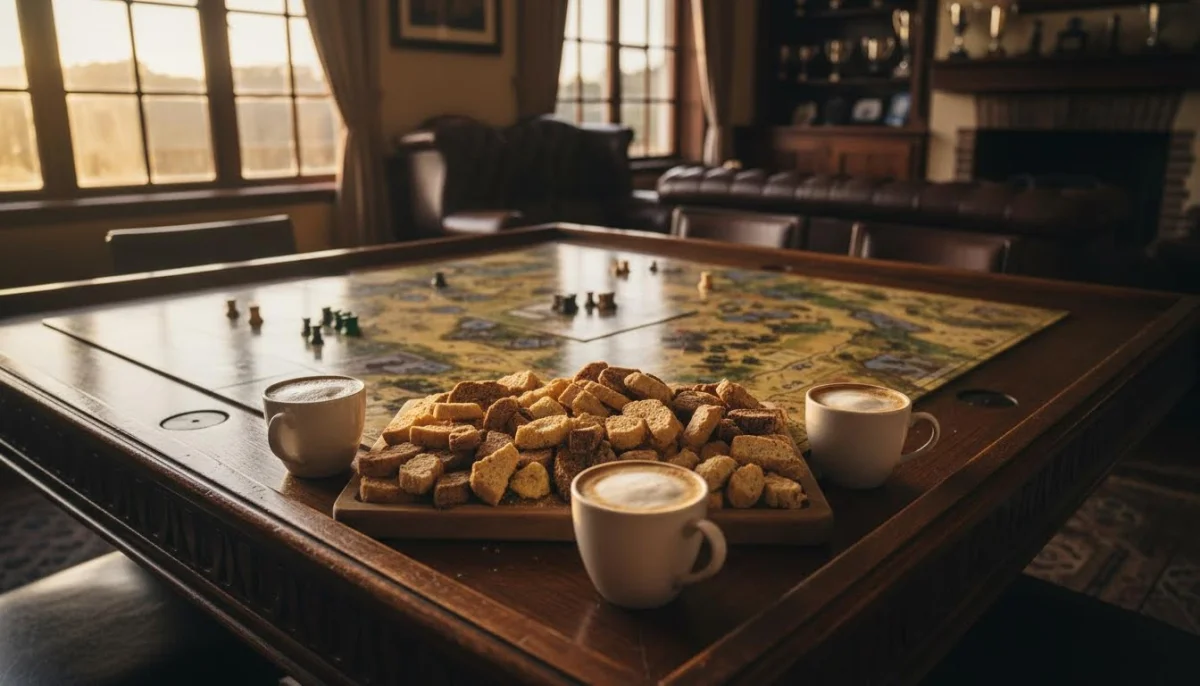
The coffee corner can also be where you place the printed score sheet or prize table. Keep it simple. A bowl of chocolates, a cheap trophy, a packet of biltong, maybe a R100 voucher if you’re feeling generous. I’ve seen adults fight harder for a plastic medal than for actual money.
If your crowd drinks, coffee still has a place. Board games and too much alcohol can get boring fast. There, I said it. One or two drinks, fine. By the third, nobody reads cards properly and every turn takes six years.
Food truck or home snacks, pick a lane
Food is where hosts lie to themselves. They say they will “just do platters,” then spend the afternoon looking for serviettes, heating mini pies and realising the vegetarian option is grated cheese next to a tomato. If you enjoy that, carry on. If not, get someone else to feed people.
A truck outside a house or estate clubhouse changes the admin. Burgers, tacos, bunny chows, pizza, boerie rolls, loaded chips. It depends what your area allows. Some estates in Fourways and Midstream are fussy about vendors at the gate, so get the rules before you pay a deposit. Not a lecture, just a dull fact that can ruin your night.
Costs depend on numbers. Some vendors charge per head, often from around R90 to R180 for casual food, more if it’s fancy or includes dessert. Others want a minimum sales amount. If your guest list is small, they may not come unless you cover the gap. Ask about travel fees, setup time, serving window and what happens if half your friends cancel because it rains.
The invite must say how food works. “Food truck from 6:30 to 8:30, host covering one meal per guest” is clear. “Snacks provided” is not clear. People arrive having eaten, or worse, arrive starving and then hover over the chips like pensioners at a church tea. Sorry, but it happens.

If you’re doing home snacks, make them board-game friendly. Nothing that drips onto cards. Nothing that needs a knife. No bright orange dust on fingers unless you want every white card sleeve stained like a school tuckshop counter. Bowls are fine, but keep wet dips away from the game table. This is boring advice. It is also correct.
There is a tiny social benefit to outside food too. People step away, order, chat, come back. The room breathes. I don’t know if that sounds too soft, but I notice it. A table that has been arguing about rules for 45 minutes needs a burger break.
A backdrop gives the night a centre
For a board game night, a custom photo wall sounds extra until you use it properly. It can hold the scoreboard, team names, game schedule and silly mugshots. It also tells guests where the main area is. In a school hall or clubhouse, that matters because big rooms feel half-empty even with 40 people.
Keep the design practical. Dark background, good contrast, not too many tiny words. If you want it to match the invite, send the designer the same colours and graphics. Ask what size you’re getting, what stand is included, whether delivery is included and how long setup takes. A small pull-up banner is cheaper. A full wall with props and lights costs more and needs space.
A decent backdrop can sit behind the prize table or near the coffee station. Put the scores there. People will check it. They will pretend they don’t care, then lean in and count points while holding a paper cup. Again, people contradict themselves.

This is also where the DIY invite becomes useful beyond the phone screen. Use the same title, same team icons and same rules. It makes the night feel planned without you explaining everything fifteen times. I know that sounds like design talk. It is really just reducing questions.
Do not make the backdrop too precious. People will lean on the stand. Someone will put a handbag against the base. A child will touch the dice props with a NikNaks finger. Choose materials that can survive ordinary humans.
One booth, not five photo gimmicks
A mirror-style photo booth works well for this kind of night because guests can use it between rounds. It does not need to dominate the room. It gives you funny photos, team shots and a reason for people who are knocked out of a game to stay involved.
Packages usually depend on hours, prints, digital gallery, props, attendant and travel. For a small private event, expect roughly R2,500 to R6,000, sometimes more if you want custom templates or unlimited prints. Confirm if the print design can match your invite. Confirm how many copies print per session. People get weird about who keeps the strip.
A 360 setup can be fun, but for board games I’d be careful. It needs space and attention. It pulls people away from tables for longer. If your night is more party than games, fine. If you actually want rounds to finish, a simple booth is cleaner.

Put booth timing on the invite. Open from 6:30, closed during final round, or whatever suits the flow. If you leave it open all night, no harm, but people may vanish during a team game. That might annoy you more than you expect.
Props should be limited. Dice, crowns, fake money, “sore loser” signs, maybe oversized cards. Not twenty hats and feather boas unless the board game theme has died and you’ve accepted it.
What to put in the invite so people arrive ready
The invite needs a few boring lines. Date. Time. Address. Gate code if there is one. Food plan. Cost if guests are paying. Dress if relevant. RSVP deadline. Team sizes. Main games. Start time for the first round. That is the dull machinery. It works.
If you are hiring people, give them the same timing. The coffee person, food vendor, host and booth attendant should not all be asking you where to stand at 6:05 while your cousin is phoning from the gate. Send one message with arrival time, setup spot and contact number. Pay deposits only once you have an invoice with the date, address and included items. Vague quotes are where nonsense starts.
For the guest version, write like a normal person. Example: “Arrive 6pm. Food from 6:30. First round 7:15. Bring one snack only if you want. No extra board games unless you check with me, we already have the lineup.” Slightly firm, not rude. Maybe rude to some people. They’ll survive.
A short video invite can help if it’s a bigger crowd. You can show the host explaining the night, quick shots of the games, and the prize. But keep it short. Nobody needs a speech. If you film it yourself, stand somewhere quiet and wipe the camera lens. Half of all DIY videos look like they were shot through margarine.
Small budget, medium budget, silly budget
Not every board game night needs all of this. I like spending where it removes work or adds a moment people will actually talk about later. I don’t like spending just because the supplier has a shiny package.
A small budget might be a designed digital invite, home snacks, your own games, and maybe a rented backdrop or printed score board if the night has a theme. You can still make it feel proper. Put more effort into timing and game selection.
A medium budget is where it gets good. Add a host for two hours, coffee service, and a decent photo wall. This suits 25 to 45 people in a clubhouse, school hall side room or bigger home. You will spend more, yes, but you also stop being the person explaining rules, making coffee and taking photos at the same time.
A bigger budget adds the food truck and booth. This is birthday territory, office social territory, or that friend group where everyone says “we should do something different” and then never books anything. If you are collecting money from guests, be clear early. Don’t surprise people with a payment link after they RSVP.

Here is a plain comparison. Not pretty, just useful.
Invite design: good for every size, usually low cost, fixes confusion early. Hosted quiz or game runner: best for mixed groups and bigger numbers, costs more, saves your voice. Coffee setup: best for longer nights, quiet value, check minimum spend. Food truck: best for 25 plus guests, reduces kitchen work, needs venue approval. Backdrop: good for photos and scorekeeping, price depends on size. Booth: fun proof of the night, best when people have gaps between rounds.
Supplier questions I would ask before paying
Ask the invite designer how many revisions are included. Two rounds is normal. Unlimited changes sounds nice until the supplier ghosts you because your group chat changed the theme five times. Ask for final files in phone-friendly sizes.
Ask the host for a sample format. Not all trivia people understand board game pacing. You want short bursts, clear scoring and someone who can handle mild arguing without turning it into a lecture.
Ask the coffee supplier what they need from the venue. Power, table, water, bin, setup space. Yes, it is boring. You still ask. Also ask how many drinks they can make per hour, because a slow coffee queue can swallow the first round.
Ask the food vendor about serving speed. A single cook making custom burgers for 50 people can become a long wait. Some menus are better for events because they move fast. Boerie rolls move. Build-your-own anything does not.
Ask the booth supplier if an attendant stays. If not, the booth becomes your problem. People will press the wrong thing, unplug something, or pose for 12 minutes while others stand there with paper plates. I prefer an attendant. I don’t even feel bad about that preference.
For the backdrop, ask about delivery and collection times. Some suppliers collect late. Some collect the next day. Some charge extra if your venue insists everything must be out by 11pm. A school hall caretaker with keys on a stretchy wristband will not care that your supplier is “on the way.”
How the night can actually run
You don’t need a military schedule, but you need some shape. Guests arrive, get food or coffee, take a team photo, then sit down for the first round. Keep the first game simple. Do not start with the hardest thing you own. That is how you lose half the room.
A workable flow: 6pm arrivals, 6:30 food opens, 7:15 first hosted round, 7:45 board game tables split, 8:45 quick quiz or score check, 9pm second game, 10pm final scores and photos. Shift it as needed. Leave gaps. People need to talk nonsense.
One small tangent. Every family has one person who arrives with a cooler box even when nobody asked. Not a small cooler bag. A proper blue cooler box with two handles and a bag of ice that leaks in the boot. That person will ask where to put it before saying hello. I have stopped fighting this. Just give them a corner.
Back to the point. The hired bits should support the game night, not swallow it. The invite points people in the right direction. The host keeps things moving. Food and coffee stop hunger and yawning. The backdrop and booth catch the faces, the sore losers, the winners holding a cheap trophy like it’s the Currie Cup.
That is what people remember. Not every supplier name. Not every colour choice. They remember who accused whom of cheating, who laughed with coffee foam on their lip, who took the game too seriously after saying they were just there for fun. Book the things that help those moments happen without making you run around all night.
Use TimeToParty to find South African suppliers for your invite, host, coffee, food, backdrop and booth. Ask for clear quotes, check what is included, and keep the night focused on the games.
Comments
Join the conversation — no account needed. Comments are moderated before they appear.
Be the first to leave a comment.
Leave a comment